


The Little Steel Box That Changed the World
The JJ Lawson crew had a brilliant day recently supporting Mary’s House Services at their annual Golf Day Fundraiser at Concord Golf Club. The event raised over $50,000 in support of helping women and children escape domestic violence and abuse.
Find out more about the great work that Mary’s House does in our local community: Say No To Domestic Abuse – Mary’s House Services
It doesn’t look particularly revolutionary.
A rectangular steel box. Usually 20 or 40 feet long. No engine, no technology and nothing particularly exciting about it.
Yet the humble shipping container changed the way the world trades.
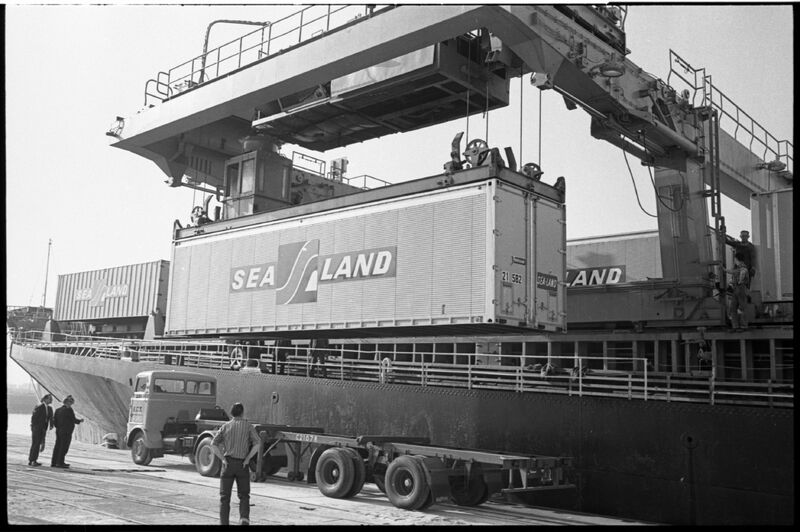
In fact, 2026 marks 70 years since the first commercially successful container voyage, when American trucking entrepreneur Malcom McLean demonstrated that standardised containers could move seamlessly between ships and trucks.
Seven decades later, that simple idea remains at the heart of global freight.
Before the container, freight was complicated
Before containers became standard, loading and unloading ships was a slow and labour-intensive process.
Goods could arrive at a port in all sorts of shapes and sizes — bags, boxes, barrels, crates and individual pieces of cargo. Each item needed to be loaded, unloaded and handled separately.
It could take days to unload and reload a ship.
There were also more opportunities for goods to be damaged, lost or stolen.
The shipping container changed all of that.
Instead of handling thousands of individual pieces of cargo, workers could load goods into a standardised box at their origin. That container could then be lifted onto a ship, transferred to a train and eventually placed onto a truck — without needing to unpack the cargo at every stage.
That concept of intermodal transport transformed global logistics.
One box. Multiple modes of transport.
This is perhaps the most brilliant thing about the container.
The container itself doesn’t care whether it’s travelling on a ship, train or truck.
Its standardised dimensions allow different parts of the transport network to work together.
A product manufactured overseas can be packed into a container, transported by road to a port, loaded onto a ship, unloaded thousands of kilometres away, transferred onto rail or another truck and eventually delivered to a warehouse or business.
The cargo stays inside the same box.
For the transport industry, that was revolutionary.
For consumers, it helped make global trade faster, cheaper and more accessible.
The container helped create the modern supply chain
It’s easy to take global trade for granted.
Walk into an Australian shop and you might find clothing manufactured in Vietnam, electronics from China, machinery from Europe or products containing components sourced from several different countries.
None of this would be as efficient without the container.
Today, containerised shipping underpins a huge proportion of global trade, with thousands of container ships moving billions of goods around the world.
And the scale continues to grow.
Infrastructure Australia forecasts significant growth in Australia’s container trade, with major ports including Brisbane and Fremantle expected to handle substantially more containerised imports in the years ahead.
From the port to the road
Of course, the journey doesn’t end when a container reaches an Australian port.
That’s where the next part of the supply chain begins.
Containers need to move from ports to distribution centres, warehouses, businesses and customers across the country.
And while ships might cross oceans and cranes might move thousands of containers at a time, eventually almost every shipment still needs to make its way along an Australian road.
That’s where road transport remains such an important part of the bigger picture.
The container may have revolutionised global trade, but it still needs people, trucks and transport networks to complete its journey.
Seventy years on, the box is still evolving
The shipping container may be 70 years old, but it certainly hasn’t stood still.
Ports are becoming increasingly automated. Tracking technology provides greater visibility. Logistics systems are becoming more sophisticated, and artificial intelligence is beginning to help businesses predict delays, optimise routes and manage increasingly complex supply chains.
The container remains the simple piece that connects much of it together.
And perhaps that’s the most impressive thing about it.
A relatively simple idea — putting freight into a standardised steel box — helped create a global logistics system that continues to evolve today.
Keeping Australia’s freight moving
At JJ Lawson, we’re part of the final stages of that journey.
Whether freight has travelled across the country or arrived from the other side of the world, it still needs to get where it’s going.
The technology may change. The trucks may change. The way we track and manage freight will certainly continue to change.
But the fundamental job remains the same:
Moving freight safely, reliably and efficiently — from where it starts to where it needs to be.
And sometimes, the biggest innovations are the simplest ones.
Happy 70th birthday to the little steel box that changed the world.